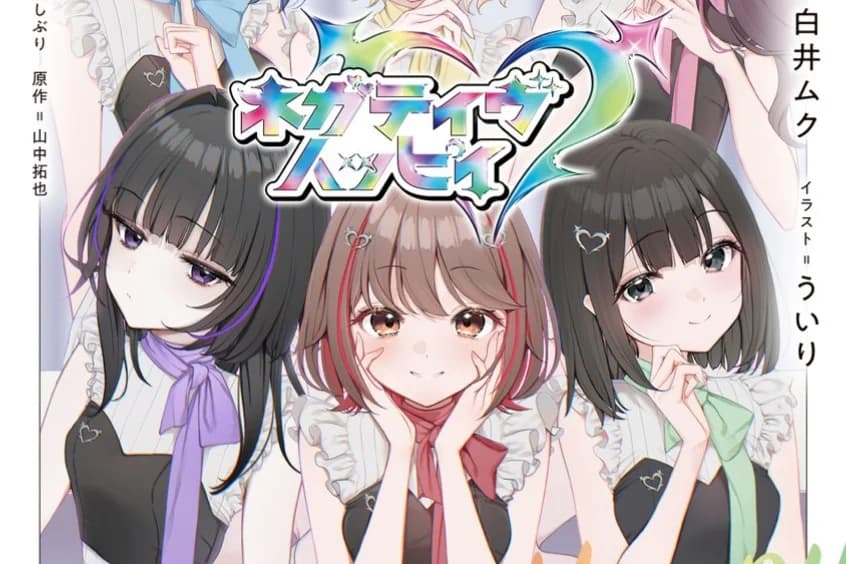
AniEvo ID – Today's news comes from KADOKAWA for all you fans of Negative Happy: Bokura dake ga Shitteiru, which is getting closer to hitting store shelves! On October 1, 2026, Fantasia Bunko finally revealed the completed cover design for the novel. It is scheduled to release on October 20, 2026 in Japan.
The novel is a print adaptation of the YouTube project Negative Happy. But don't expect it to simply be a prose version of the existing short anime. This time, the story takes a different angle, focusing on the people who are fans of the six Negative Happy idols.
What makes it even more interesting is that the novel is split into two parts by two different writers. Muku Shirai handles the first part, while Negative Happy's original creator, Takuya Yamanaka, takes over the second.
The Final Cover Is Finally Here!
Before the final version was shown, Fantasia Bunko had already introduced the cover illustration on August 25.
The illustration features all six members of Negative Happy in a single image. All six are presented with a neat, pretty idol image, looking as if they don't have a single problem in the world.
But Negative Happy fans surely know the reality isn't that simple.
Then, on October 1, Fantasia Bunko finally showed off the completed cover design. In other words, it's not just the illustration anymore, but the full package with the book title, creator names, credits, and the various design elements that will actually appear on store shelves.
Visually, it isn't very different from the earlier illustration. Still, this version gives a final look at what the book will be like when it officially releases.
Interestingly, all six members are still shown together. This suggests the novel doesn't revolve around just one heroine.
Instead, Negative Happy as a group sits at the center of the six stories in the book.
On the surface, they look like perfect idols. But readers who have followed the original project know their lives are actually far more chaotic.
This Time, the Camera Turns to the Fans
One of the most interesting things about Bokura dake ga Shitteiru is its point of view.
The novel doesn't just take stories from the short anime and turn them into prose. KADOKAWA has prepared six new stories that show Negative Happy from the perspective of people outside the group.
And those people are the fans.
There's a boy stressing out over his exams.
There's a man who still hasn't gotten over a past relationship.
And there's a girl who sees Negative Happy and starts chasing her own dream.
They may have no direct connection to the six idols. Even so, Negative Happy's presence still leaves a mark on their lives.
And when you think about it, that's incredibly relatable for anyone in a fandom.
Sometimes we never actually meet the idols we love, yet their songs, videos, characters, or simply their existence can still mean a great deal in our lives.
That's exactly the concept the novel is trying to explore.
Negative Happy Seen from a Different Side
While the short anime lets us see firsthand just how absurd the lives of the six Negative Happy members are, the novel takes us to the opposite side.
The fans only know them through their public image.
They see pretty idols, cool songs, engaging videos, and performances that look flawless.
Meanwhile, readers already know that behind the scenes, things aren't always so rosy.
This is where the information gap between the characters and the reader comes into play.
To a fan in the story, Negative Happy might seem like a source of encouragement, or even something that changes their life.
But readers who already know the group's other side will naturally see the situation differently.
So it's not just about "idols and fans", but also about image, expectations, fandom, and how someone can find meaning in a figure who doesn't even really know them personally.
Muku Shirai and Takuya Yamanaka Take Turns Writing
The book's writing structure is just as intriguing.
The novel is divided into two parts.
The first part is written by Muku Shirai, and the second part is continued by Takuya Yamanaka, Negative Happy's original creator, who also serves as the project's director and scriptwriter.
This switch in writers isn't just an ordinary division of labor.
According to Takuya Yamanaka, when he was first offered the chance to make a novel, he considered turning it down.
However, after some discussion, a concept emerged that gave the novel format its own reason to exist as part of Negative Happy.
In other words, the change of writers is actually part of the story's concept.
Fantasia Bunko has even teased that the latter half of the novel will make readers look back at the first half with a different understanding.
In short, once we reach the last page, we might just want to flip right back to the beginning.
Full details on how the six stories are split have yet to be revealed.
So for now, all we know is that Muku Shirai opens the story and Takuya Yamanaka takes over for the following part.
From Cute Idols to Agents of Chaos
For those unfamiliar, Negative Happy has a pretty unique concept.
On one hand, they look like a regular idol group with attractive visuals, songs, Music Videos, costumes, and an all-around polished idol image.
On the other hand, the Negative Happy short anime shows their lives to be far more absurd.
Each of the six members has her own personality and problems. There are conflicts, weird habits, decisions that make you shake your head, and conversations that are sometimes completely random.
So the contrast between "idols in front of the camera" and "real people behind the scenes" has been one of Negative Happy's main draws from the very beginning.
Now, the novel adds a third perspective.
Rather than just seeing them as idols or seeing their lives behind the scenes, we get to see how other people view them.
And since those people are fans, the gap between Negative Happy's public image and reality becomes all the more fascinating.
The Six Members Remain the Main Stars
Although the stories largely use the fans' point of view, the six members of Negative Happy remain at the heart of it all.
They are:
- Yuhi Fujimaru — Hina Kino
- Sena Tsuwabuki — Kanoko Sudo
- Hanako Kusunoki — Miyuri Shimabukuro
- Chloe Takanashi — Shion Wakayama
- Manaka Tomonaga — Sumire Morohoshi
- Ayase Ito — Hitomi Ueda
Each has a different personality and different problems, so the group's dynamic doesn't hinge on just one character.
In the short anime, their chemistry is explored through dialogue and comedy.
Meanwhile, the Music Videos show their more controlled side as idols.
Now, the novel Bokura dake ga Shitteiru adds yet another layer: how they appear to people who only know them as idols.
So for readers, there will be a gap between what the characters in the story know and what Negative Happy fans already know from the earlier project.
342 Pages, Priced at 924 Yen
Physically, the novel will be published in bunko format by Fantasia Bunko, running approximately 342 pages.
The official price is set at 924 yen including tax, or 840 yen before tax.
The book carries the ISBN 978-4-04-076565-5, and measures approximately 105 × 149 × 16.2 mm.
The official Japanese release is scheduled for:
October 20, 2026 Fantasia Bunko 342 pages 924 yen including tax
Pre-orders are also already open through several Japanese retailers.
Fantasia Bunko will likely share more information as release day approaches, possibly including previews, story details, or purchase bonuses.
For now, though, one thing still under wraps is the full structure of the six stories and exactly how the handover between writers happens midway through the novel.
And judging by how the publisher is promoting it, that part seems to be deliberately kept secret so readers can discover the answer for themselves once the book is out.
So for those who have followed Negative Happy on YouTube, Bokura dake ga Shitteiru could be a chance to see these six idols from a completely different angle.
It's not just about what they do behind the scenes, but also about how their existence can change the lives of people who only know them through a screen.